Choosing the right grain storage solution is an important decision for farms, agricultural companies, and grain processing factories. Among various storage options, steel silos and concrete silos are two common choices used worldwide.
Both types of silos can provide effective grain storage, but they have significant differences in construction method, cost, installation speed, maintenance requirements, and flexibility.
With the development of modern agricultural technology, more companies are choosing steel grain silos because of their efficient installation process, durability, and adaptability.
This article compares steel silos vs concrete silos and explains why steel silo solutions are becoming increasingly popular in modern grain storage.
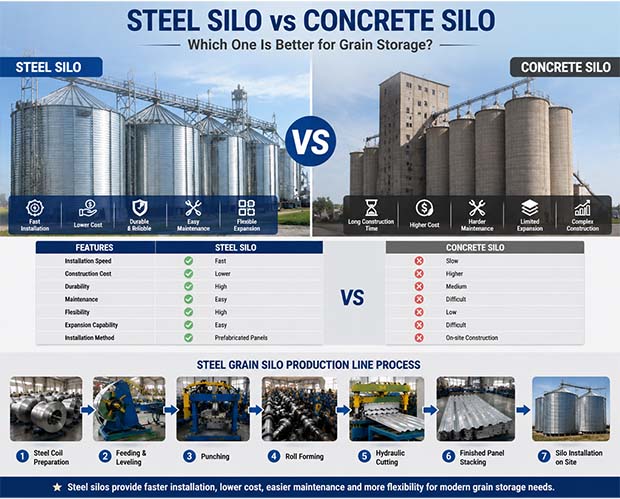
A steel grain silo is a storage structure made from galvanized steel panels manufactured by specialized equipment.
The panels are produced using a steel silo production line, which includes:
After production, steel silo panels are assembled on-site to create complete grain storage systems.
Steel silos are widely used for storing:
A concrete silo is a traditional storage structure built mainly from reinforced concrete.
Concrete silos are usually constructed through:
They have been used for many years, especially in large permanent storage facilities.
However, concrete silos usually require longer construction periods and more complex installation processes.
Steel silos use prefabricated panels manufactured by a grain silo manufacturing machine.
Advantages:
Concrete silos require:
The construction process is usually much longer.
Winner: Steel Silo
The cost of a silo depends on size, capacity, materials, and design.
For many agricultural businesses, steel silos provide a more cost-effective storage solution.
Winner: Steel Silo
Modern steel silos use galvanized steel materials with excellent corrosion resistance.
Benefits:
Concrete silos also provide good durability but may experience:
Winner: Steel Silo
Agricultural businesses often need to expand storage capacity.
Advantages:
Limitations:
Winner: Steel Silo
Maintenance is an important factor for long-term operation.
Winner: Steel Silo
| Feature | Steel Silo | Concrete Silo |
|---|---|---|
| Installation Speed | Fast | Slow |
| Construction Cost | Lower | Higher |
| Expansion Capability | Excellent | Limited |
| Maintenance | Easy | More Difficult |
| Flexibility | High | Low |
| Installation Method | Prefabricated Panels | On-site Construction |
| Customization | Easy | Limited |
Modern agriculture requires storage solutions that are:
Steel silos meet these requirements because they are manufactured with advanced grain silo equipment and can be customized according to different storage needs.
Manufacturers using automatic silo production lines can provide:
The production process includes:
Raw galvanized steel coils are prepared for production.
The silo roll forming machine creates accurate panel profiles.
Automatic systems prepare panels for installation.
Finished components are checked before shipment.
A professional steel silo machine ensures stable quality and efficient production.
Steel silos are commonly used in:
They provide reliable storage solutions for different industries worldwide.
Before selecting a silo system, consider:
Choose a design according to your grain storage requirements.
Different environments may require different protection levels.
Consider whether additional storage capacity may be needed.
Choose a supplier with experience in:
Xinnuo Machinery Co., Ltd., established in 1995, is a professional manufacturer of grain silo machines and roll forming production lines with nearly 30 years of experience. With advanced CNC facilities and a strong R&D team, we provide high-quality, customized solutions for global customers. Our machines are widely used in modern grain storage systems, ensuring high efficiency, stability, and long service life.
...[ Read More >>]