The demand for efficient grain storage solutions is increasing worldwide due to the growth of agriculture, food processing, and feed industries. For companies planning to manufacture steel grain silos, choosing the right grain silo production line is one of the most important investment decisions.
A suitable silo production line can help manufacturers improve production efficiency, reduce operating costs, and provide high-quality grain storage products to customers.
However, different factories have different requirements. Factors such as production capacity, material thickness, automation level, and product specifications all affect equipment selection.
This guide explains the key factors to consider when choosing the right grain silo manufacturing equipment for your factory.
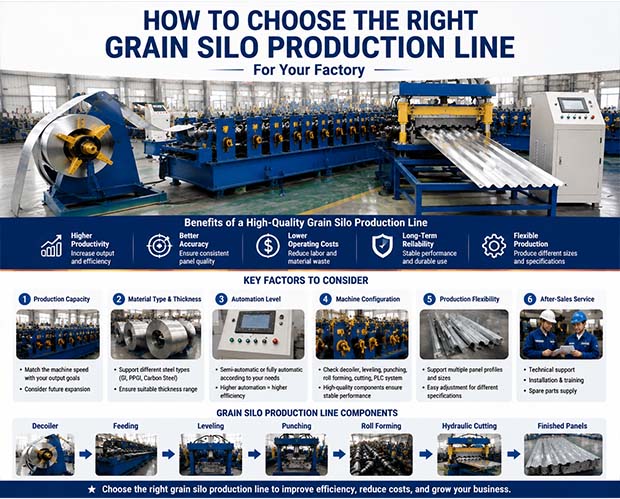
A grain silo production line is a complete manufacturing system used to produce steel silo components, including sidewall panels, roof panels, and other structural parts.
A modern production line usually includes:
Through automatic processing, steel coils can be transformed into accurately formed silo panels ready for assembly.
The equipment configuration directly affects:
A properly designed production line can increase output and reduce production time.
Accurate forming and cutting ensure consistent silo panel dimensions.
Efficient equipment reduces labor requirements and material waste.
A flexible production system allows manufacturers to expand their product range.
The first step is understanding your expected production volume.
Different factories may have different goals:
Suitable for companies entering the grain storage equipment industry.
Requirements:
Suitable for professional silo suppliers.
Requirements:
Suitable for high-volume production.
Requirements:
Choosing the correct capacity prevents unnecessary investment while ensuring future growth.
The material used for silo panels directly affects machine configuration.
Common materials include:
Different thicknesses require different machine structures.
Thicker steel materials may require:
Before purchasing equipment, confirm:
Automation is an important factor in modern silo manufacturing.
Advantages:
Advantages:
For large-scale production, an automatic grain silo machine provides better long-term benefits.
A reliable grain silo production line should include high-quality components.
Important parts include:
Ensures stable steel coil feeding.
Improves material accuracy before forming.
Creates precise connection holes.
Shapes steel strips into silo panels.
Provides accurate panel length control.
Allows automatic operation and parameter adjustment.
The quality of these components directly influences machine performance.
Modern customers require different silo sizes and designs.
A flexible silo manufacturing machine should support:
Flexible equipment allows manufacturers to serve more markets and customer groups.
Before purchasing equipment, evaluate your factory conditions.
Important factors include:
A professional supplier can help design a suitable production layout.
Selecting the right supplier is as important as selecting the equipment.
A reliable manufacturer should provide:
Experienced suppliers can provide solutions based on your production requirements instead of only selling standard machines.
A reliable production line provides:
Automatic processing improves manufacturing speed.
Precision forming ensures consistent silo components.
Reduced labor and material waste improve profitability.
Quality equipment provides stable operation for years.
The cheapest machine may not provide the best long-term value.
A machine should support future business growth.
Technical support is essential for continuous production.
Oversized or undersized equipment can increase unnecessary costs.
Xinnuo Machinery Co., Ltd., established in 1995, is a professional manufacturer of grain silo machines and roll forming production lines with nearly 30 years of experience. With advanced CNC facilities and a strong R&D team, we provide high-quality, customized solutions for global customers. Our machines are widely used in modern grain storage systems, ensuring high efficiency, stability, and long service life.
...[ Read More >>]