With the continuous growth of agricultural storage demand, steel grain silos have become an important solution for storing wheat, corn, rice, and other bulk materials. To manufacture high-quality silo panels efficiently, many factories use a grain silo roll forming machine.
A grain silo roll forming machine is a specialized production system designed to transform steel coils into accurately shaped silo wall panels and structural components. Through automatic feeding, punching, roll forming, and cutting processes, manufacturers can produce consistent silo panels with high efficiency.
This article explains the working principle, production process, main components, and advantages of a modern steel silo production line.
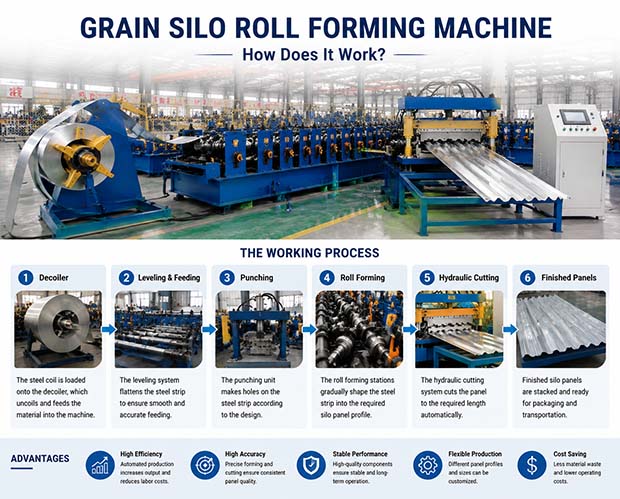
A grain silo roll forming machine is industrial equipment used to manufacture steel panels for grain storage silos.
The machine processes galvanized steel coils or other metal materials through multiple forming stations to create specific profiles required for silo assembly.
Compared with traditional manual production methods, automatic silo forming equipment provides:
A complete silo production system can produce:
The production process of a grain silo roll forming machine usually includes several important steps.
The process starts with loading galvanized steel coils onto the decoiler.
The decoiler automatically releases the steel strip and provides continuous material feeding for the production line.
Main functions:
The quality of the feeding system directly affects the final panel accuracy.
After uncoiling, the steel strip passes through a leveling system.
This step removes deformation from transportation and storage, ensuring the material enters the forming section evenly.
Benefits:
Before forming, the machine can perform automatic punching according to silo panel design requirements.
The punching system creates holes for:
Automatic punching improves efficiency compared with manual drilling.
The core part of the machine is the roll forming system.
Multiple rollers gradually shape the flat steel strip into the required silo panel profile.
The process includes:
Each forming station works continuously to ensure:
After reaching the required length, the hydraulic cutting system cuts the formed panel automatically.
Advantages:
This allows manufacturers to produce silo panels with different sizes according to customer requirements.
Modern grain silo roll forming machines are equipped with PLC control systems.
Operators can set:
The automatic control system helps improve production efficiency and reduces operation errors.
A complete silo manufacturing machine usually includes:
Used for loading and feeding steel coils.
Controls the movement of raw materials.
Creates connection holes for silo installation.
Forms steel sheets into silo panel profiles.
Cuts panels according to programmed dimensions.
Controls the entire production process.
Automatic processing allows continuous production and reduces manual operations.
Manufacturers can produce more silo panels in less time.
Precision rollers ensure every panel has consistent dimensions.
This helps:
Automation reduces labor requirements and minimizes material waste.
Over time, this improves production profitability.
A customized grain silo roll forming machine can be designed according to:
Before purchasing equipment, manufacturers should consider:
Choose a machine based on expected output requirements.
Different steel thicknesses require different machine structures.
Automatic systems provide higher efficiency and easier operation.
An experienced manufacturer can provide better technical support and customized solutions.
For companies entering the grain storage equipment industry, a reliable grain silo manufacturing machine is essential.
A professional production line helps manufacturers:
With advanced roll forming technology and automatic control systems, modern silo equipment provides an efficient solution for producing steel grain silos.
Xinnuo Machinery Co., Ltd., established in 1995, is a professional manufacturer of grain silo machines and roll forming production lines with nearly 30 years of experience. With advanced CNC facilities and a strong R&D team, we provide high-quality, customized solutions for global customers. Our machines are widely used in modern grain storage systems, ensuring high efficiency, stability, and long service life.
...[ Read More >>]