With the increasing demand for efficient grain storage solutions, steel silos have become widely used in agriculture, feed production, and grain processing industries. A modern steel silo requires precise manufacturing technology to ensure durability, sealing performance, and long service life.
The grain silo manufacturing process involves multiple production stages, including steel coil preparation, leveling, punching, roll forming, cutting, and quality inspection.
By using an advanced steel silo production line, manufacturers can produce high-quality silo panels efficiently while reducing production costs and improving consistency.
This article explains the complete manufacturing process of grain silos and the role of modern silo production equipment.
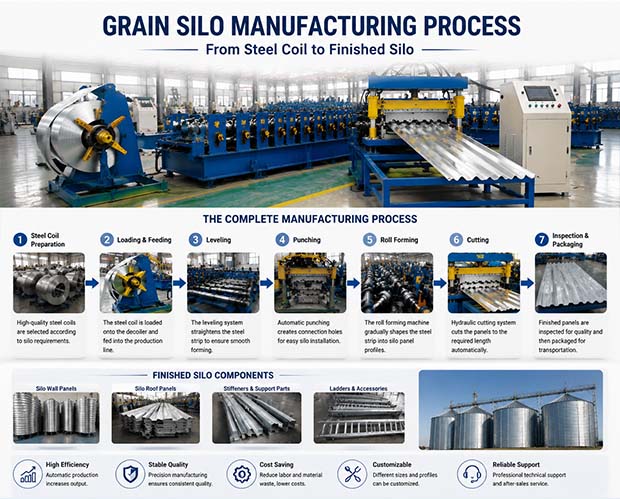
The grain silo manufacturing process refers to the complete procedure of producing steel silo components from raw materials to finished products.
A typical manufacturing process includes:
Modern manufacturers use automatic grain silo equipment to improve production efficiency and ensure accurate panel dimensions.
The manufacturing process starts with selecting suitable steel materials.
Common materials include:
The material selection depends on:
High-quality steel materials provide better durability and help extend the service life of grain storage silos.
The steel coil is installed on the decoiler of the silo production line.
The decoiler automatically releases the steel strip and feeds the material into the forming system.
Main functions include:
A reliable feeding system is important for maintaining production accuracy.
Before forming, the steel strip passes through a leveling system.
During transportation, steel coils may have slight deformation. The leveling process removes these irregularities and prepares the material for precise forming.
Benefits:
Silo panels require connection holes for assembly.
The automatic punching unit creates accurate holes according to the silo design.
Advantages of automatic punching:
This step improves installation efficiency when assembling the final silo structure.
The roll forming process is the core stage of grain silo manufacturing.
A silo roll forming machine uses multiple roller stations to gradually shape flat steel strips into designed panel profiles.
The forming process includes:
Advantages of roll forming technology:
After the steel panel reaches the required length, the hydraulic cutting system automatically cuts the finished panel.
The cutting system provides:
This allows manufacturers to produce different silo panel sizes according to customer needs.
After production, finished silo panels are inspected to ensure they meet quality requirements.
Inspection items include:
Qualified panels are then packaged and prepared for transportation and silo installation.
A complete grain silo production line usually includes:
Used for steel coil loading and feeding.
Ensures smooth and accurate material processing.
Creates connection holes for silo assembly.
Forms steel sheets into silo panel profiles.
Cuts panels automatically according to production requirements.
Controls the entire production process automatically.
Automatic production reduces manual operations and increases output capacity.
Precision forming technology ensures consistent silo panel dimensions.
Automation reduces labor requirements and minimizes material waste.
Manufacturers can customize production according to different silo designs and requirements.
Before investing in silo production equipment, manufacturers should consider:
Choose equipment based on expected market demand.
Different steel thicknesses require different machine configurations.
Automatic systems provide higher efficiency and easier operation.
A professional manufacturer can provide technical support and customized solutions.
Advanced manufacturing technology directly affects the performance of steel silos.
A reliable steel silo machine helps manufacturers:
For companies planning to enter the grain storage equipment industry, investing in modern silo manufacturing technology creates long-term business advantages.
Xinnuo Machinery Co., Ltd., established in 1995, is a professional manufacturer of grain silo machines and roll forming production lines with nearly 30 years of experience. With advanced CNC facilities and a strong R&D team, we provide high-quality, customized solutions for global customers. Our machines are widely used in modern grain storage systems, ensuring high efficiency, stability, and long service life.
...[ Read More >>]